
Compare / Search seasonality
Best keyword seasonality tools in 2026: find when demand peaks
Six ways to see when people start searching for something, when they stop, and how big the peak is. Most are free; they differ in whether they show real search numbers.
The six at a glance
| Tool | Price | What it shows | History | Best for |
|---|---|---|---|---|
| Search Seasonality Ours | Free | Monthly search volume, peak month, when demand starts rising | About 8 years | Planning content before a season |
| Google Trends | Free | Relative interest, 0 to 100 | Back to 2004, up to the last hour | Spotting the shape and breaking interest |
| Google Keyword Planner | Free with Google Ads | Monthly search volume (ranges without ad spend) | Up to 4 years | Volumes straight from Google |
| Glimpse | Free sign-up; paid plans | Absolute volume added to Google Trends, trend forecasts | Follows Google Trends | Using Trends with real numbers |
| Exploding Topics | $39 | A curated database of growing topics | Multi-year trend lines | Finding new topics before they peak |
| Semrush, Ahrefs | Paid suites | A volume trend per keyword, beside rankings and links | Varies by tool | Teams already paying for one |
Our tool is listed first and marked Ours; the rest are by price, free first, and none paid to be here. Prices checked on each company's own site on 22 October 2026.
Monthly prices before tax. Search volumes from every tool are estimates: Google rounds them into bands and may combine close variants of a phrase.
How we compared them
- Real numbers or an index: does it say how many searches, or only the shape?
- History: one year can't tell a season from a fluke. You need several.
- Answers, not just charts: does it tell you the peak month and when the rise begins?
- Keyword lists: can it check a whole content plan at once?
- Cost to start.
The six, in detail
01Search Seasonality (DATA HIT) Ours
- Best for
- Knowing when to publish: the peak month, how reliable it is, and when demand starts to rise
- Price
- Free. One keyword needs no account; keyword sets of 10 need a free account, 200 on Pro Solo and 700 on Pro Agency
- Data
- About eight years of monthly Google search volume, by country
- Worth knowing
- Monthly figures, so it won't show this week's spike; Google search only
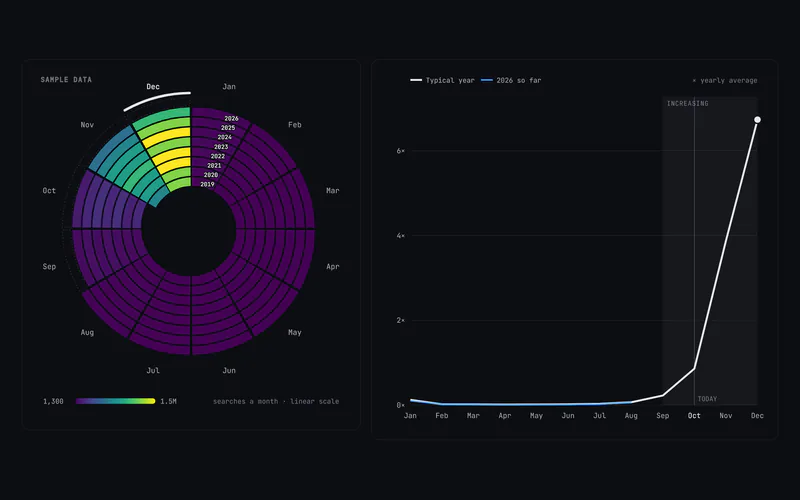
Search Seasonality draws a keyword's monthly searches as a spiral, one turn per year, so a season that repeats lines up and a one-off doesn't. Beside it, a typical year shows the median month and when the rise begins. It says how many past years peaked in the same month ("peaked in December in 7 of 7 years"), and flags keywords with no real season. Give it a list, by paste, CSV or Search Console import, and it becomes a calendar sorted by peak month, with what's increasing now and what starts increasing within four months.
Where others are better: Google Trends is closer to real time and covers YouTube, News and Shopping searches as well as web search. Exploding Topics finds topics you hadn't thought of; we only look up the ones you give us. The figures describe past patterns; they aren't a forecast.
02Google Trends
- Best for
- A free, instant view of the shape of demand, by region, and anything breaking right now
- Price
- Free
- Data
- Relative interest from 0 to 100, back to 2004; compare up to five terms
- Worth knowing
- No search numbers: 100 is just the busiest point in your chosen range
Trends is the first place to look and it is very good at what it does. Set the range to five years and a seasonal keyword's pattern is obvious. Because the scale is relative, though, you can't tell whether a peak is 500 searches or 500,000, and low-volume terms drop to zero. Use it with a volume source.
03Google Keyword Planner
- Best for
- Monthly volumes from Google itself, for a list of keywords
- Price
- Free with a Google Ads account
- Data
- Monthly search volume, up to four years back
- Worth knowing
- Without an active ad campaign, volumes show as broad ranges
Keyword Planner is where most volume figures start. Download a list's monthly searches and you can chart the season yourself in a spreadsheet. It is built for advertisers, so finding the peak month, and checking that it repeats, is left to you.
04Glimpse
- Best for
- People who live in Google Trends and want the real numbers beside it
- Price
- Free sign-up and Chrome extension; paid plans for more searches
- Data
- Absolute search volume and growth for any keyword and country, trend forecasts with seasonality removed
- Worth knowing
- Several unrelated products share the name; this is meetglimpse.com
Glimpse's extension adds absolute volume, growth rates and a trend line to Google Trends pages, and its own site lets you discover trends by category and set alerts. Its forecasts deliberately strip out seasonality to show the underlying trend, which is useful for a different question from "when does this peak?".
05Exploding Topics
- Best for
- Discovering topics that are growing before they go mainstream
- Price
- From $39 a month (Entrepreneur), $99 (Investor), $249 (Business); 7-day free trial
- Data
- A curated database of over a million trends, with growth and search metrics
- Worth knowing
- Built for spotting growth, not for timing a keyword you already target
Exploding Topics answers "what should we be writing about?" rather than "when should we publish this?". Its trend pages show long-run growth, and the curation saves a lot of digging. Pair it with a seasonality view once you've picked the topics.
06Semrush and Ahrefs keyword tools
- Best for
- Teams that already pay for one, and want seasonality beside difficulty and rankings
- Price
- Part of their paid plans
- Data
- A monthly volume trend chart on each keyword's overview
- Worth knowing
- A trend chart per keyword; working out the peak month across a list is manual
If you already pay for either suite, the volume trend on each keyword is a quick check, and it sits beside everything else you need to choose a target. Neither is worth buying for seasonality alone.
How to find when a keyword peaks, in four steps
- Look at five years or more. One year can't separate a season from a news story.
- Find the month that peaks most often, not the single highest month. If the peak moves around, treat it as a looser season.
- Find where the rise starts. That is your publishing deadline, not the peak itself.
- Check the size. A clear season on 50 searches a month may not be worth a page.
Search Seasonality does the four steps for you; Google Trends plus Keyword Planner gets you there by hand.
Frequently asked questions
How do I find out when a keyword is most searched?
Look at several years of monthly search volume, not one year, and find the month that peaks most often. Google Trends shows the shape for free; a tool with absolute monthly volume, such as Search Seasonality or Keyword Planner, also tells you how big the peak is.
Does Google Trends show search volume?
No. Google Trends shows relative interest on a 0 to 100 scale, where 100 is the busiest point in the range you picked. It shows the shape of demand but not the number of searches.
How far ahead should I publish seasonal content?
Before demand starts to rise, not when it peaks. A page needs time to be crawled and to rank, so for most sites that means publishing or refreshing two to three months before the month when searches begin to climb.
What is a seasonal keyword?
A keyword whose search volume rises and falls at the same time each year, such as a holiday, a tax deadline or a weather-driven product. Steady keywords are searched about as often in every month.
Can I check seasonality for a whole keyword list?
Yes. Search Seasonality turns a keyword set into a demand calendar sorted by peak month: 10 keywords on a free account, 200 on Pro Solo and 700 on Pro Agency. Keyword Planner and the paid SEO suites also export monthly volumes for a list, which you can chart yourself.